
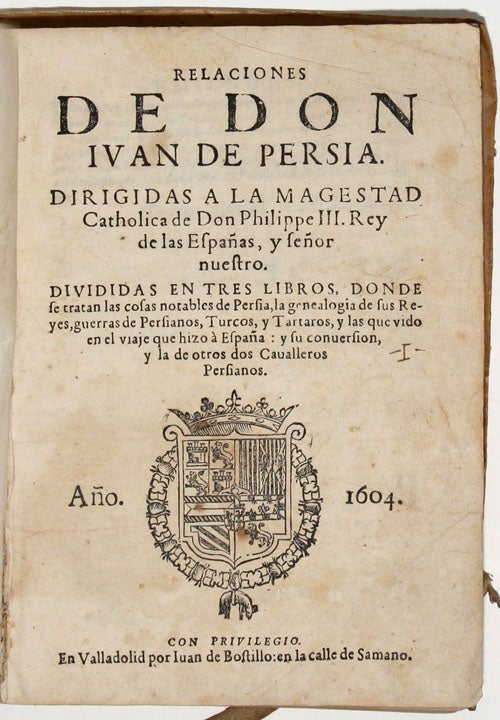

Relaciones de Don Juan de Persia.
4to (20 x 14.5 cm), [12] ff., 175 pp., [13] ff. Bound in contemporary limp vellum, title in ink on spine, some staining to front cover, remnants of ties; marginal tear at p. 41, Paper flaw affecting several letters of text at upper corner of p. 55, otherwise internally excellent.
First edition of a rare and enigmatic text with its origins in a Persian-language travel diary of Uruch Beg Bayat (1560-1605), a nobleman and secretary in the delegation sent to Europe in 1599 by the Safavid ruler Shah ‘Abbas I at the urging of Sir Anthony Sherley (1565-1635), whose own Persian narrative (Relation of His Travels into Persia, London, 1613) mirrors some of the content presented here. Beg converted to Catholicism in Valladolid in 1601, altered the target audience of his text from Iranian court to Spanish public, and took for himself the name “Don Juan of Persia.” As Don Juan, and with the substantial help of the his mentor, Alonso Remón (1561-1632), a celebrated writer and preacher and member of the Order of the Blessed Virgin Mary of Mercy (OdeM), he translated his text into Castilian, amplified its contents with references to scholarly sources, and published the work in 1604 as the Relaciones de Don Juan de Persia. All traces of the Persian “original” have been lost.
The Relaciones is divided into three parts, the first two treating Persia, and the third focusing on the 1599-1602 European embassy of Shah ‘Abbas. Part One presents details of Persian political structures, rituals, customs, and geography, adding to these a history of Islam up until the rise of the Ottoman state. Part Two focuses on the history of the Safavids from the household’s beginnings through their latest conflicts with the Ottomans in 1578-1590. Here Don Juan – and one suspects that Alfonso Remón is behind much of this research – leans heavily on the universal geographies of Giovanni Botero and Petrus Amianus, histories of classical antiquity by Strabo, Procopius, and Nicephorus Callistus, and earlier eyewitness accounts such as the Venetian Thomas Minadoi’s Historia della Guerra fra Turchi et Persiani (1588).
Don Juan then offers intriguing first-hand information about the 1599 journey of the Safavid embassy, numbering some 50 people, traveling via the Caspian Sea and Russia to meet with European heads of state. Nominally led by the chief ambassador, Husain Ali Beg, the embassy was conceived in a meeting between Shah ‘Abbas and the English adventurer Sir Anthony Sherley, their objective being the opening of trade routes and, more pointedly, the cultivation of a European-Persian alliance against the Ottoman Empire. The embassy was not a success: Although received by the Holy Roman Emperor Rudolph II, the former Duke of Bavaria Wilhelm II, Vincenzo Gonzaga of Mantua, and King Phillip III of Spain, the Safavids were denied a meeting by the Doge of Venice, and plans to speak with the courts of France, England, Scotland and Poland were abandoned. Don Juan claims that Sherley sold off a fortune’s worth of gifts intended by the Shah for foreign potentates. Several diplomats converted to Catholicism in Rome, more in Valladolid (perhaps a better alternative than returning to Persia to face the wrath of Shah ‘Abbas). In 1605 Don Juan of Persia was killed in a street brawl in Valladolid.
Of notable interest are the laudatory poems to Don Juan that precede the Relaciones, especially those by two of his contemporary female admirers, Doña Ana de Espinosa y Ledesma and Doña Bernarda de Paz y de Pastrana. Doña Ana’s short poem celebrates Don Juan for his literary skills and military prowess (“Don Juan de Persia ha mostrado, Con darnos sus relaciones, Que tiene dos coraçones, De estudiante y de soldado”; “Don Juan of Persia has shown, in giving us his relations, that he has two hearts, that of a student and that of a soldier”). In her sonnet, Doña Bernarda compares Persia’s riches to the soothing and civilizing power of Spain, which baptizes Uruch Beg and transforms him into Don Juan, a faithful Spanish subject (“Persia a Uruch Bec a nuestra España embia, Y España con su termino suave, Haze un Do[n] Juan del Uruch Bec q[ue] alabe, La ley y el Rey, que alla no conocia”; “Persia sent Uruch Bec to our Spain, and Spain with its soft words makes a Don Juan of Uruch Bec, who praises the law and the king that he did not know there”).
OCLC lists U.S. copies at Yale, Harvard, Kansas, Michigan, Minnesota, Columbia, Berkeley, Chicago, Boston Public Library.
* Palau 223840; Cyrus Ghani, <i>Iran and the West: A Critical Bibliography</i> (Routledge, 1987), p. 379; Nasrin Rahimieh, “A Conversion Gone Awry,” in <i>Missing Persians: Discovering Voices in Iranian Cultural History</i> (Syracuse University, 2001), pp. 21-38; Prem Poddar, “Don Juan of Persia: Diaries of Uruch Beg (b. 1560),” in Tabish Khair, ed., <i>Other Routes: 1500 Years of African and Asian Travel Writing</I> (Indiana University, 2005), pp. 173-183; Guy Le Strange, trans., <I>Don Juan of Persia: A Shi’ah Catholic 1560-1604</I> (London: Routledge, 1926).
Price: $12,500.00