
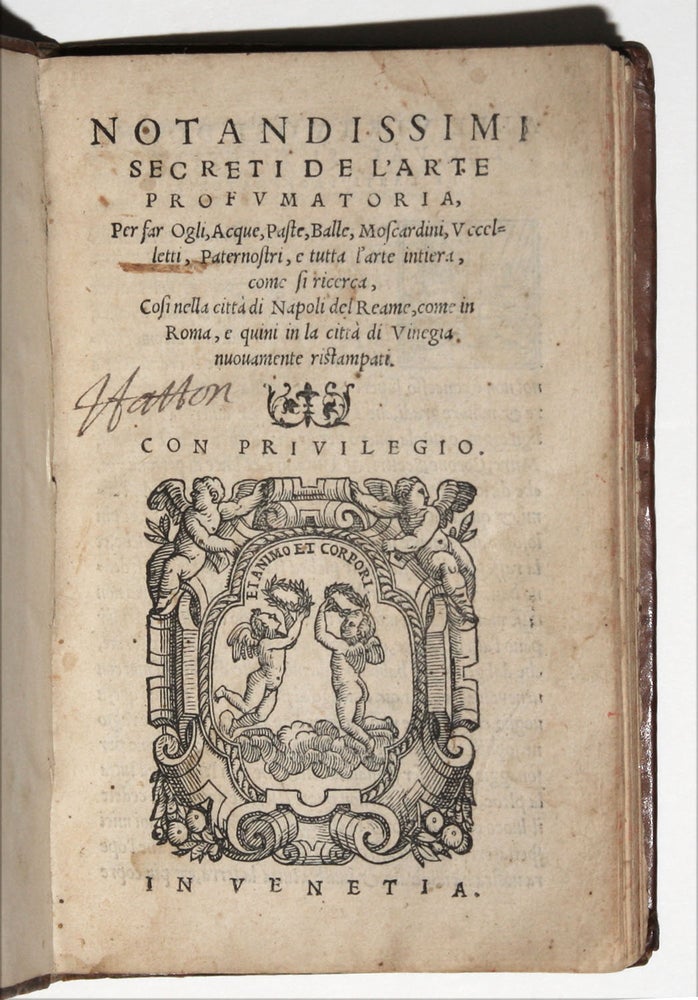
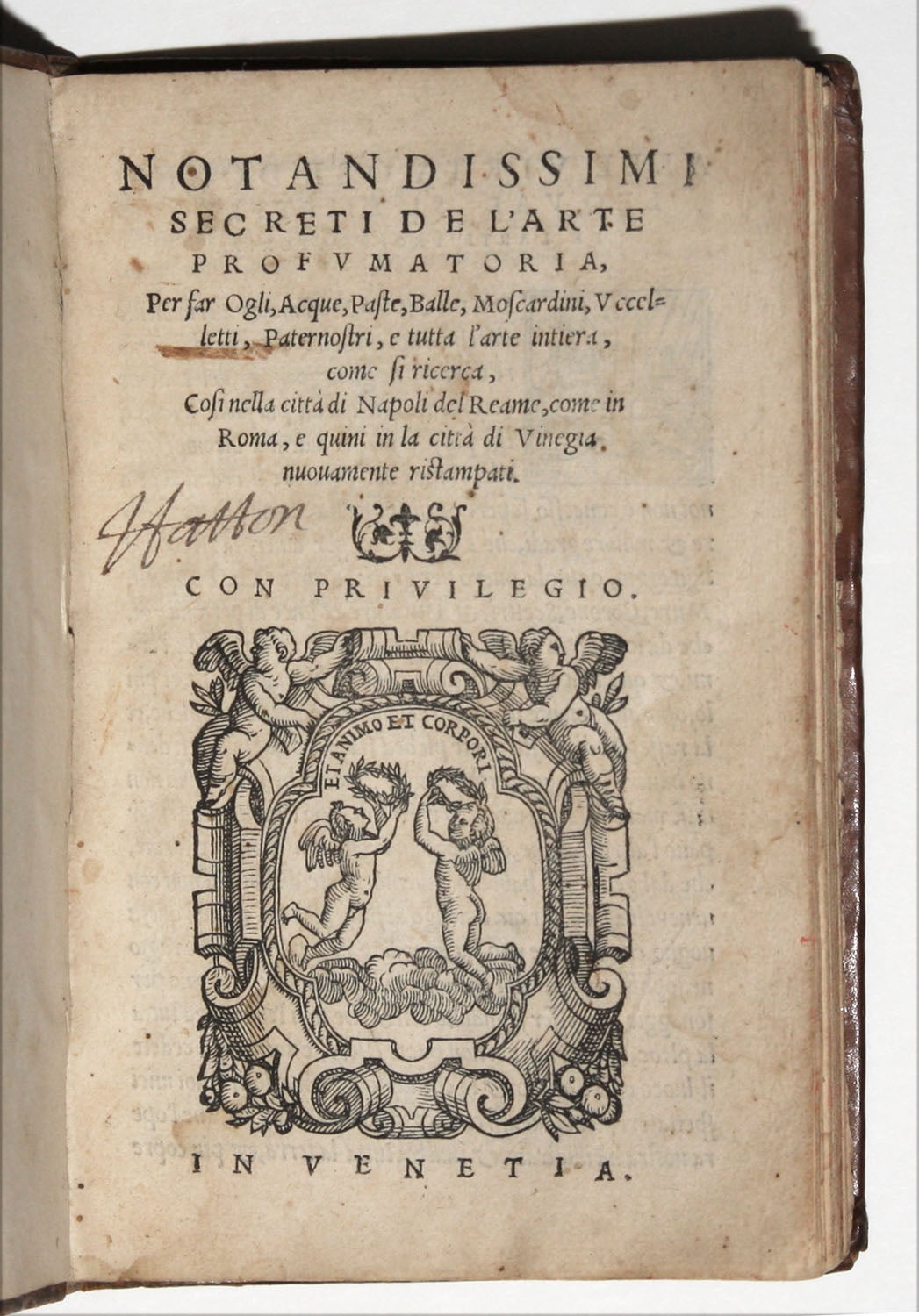
Notandissimi secreti de l’arte profumatoria, per far ogli, acque, paste, balle, moscardini, uccelletti, paternostri e tutta l’arte intiera, come si ricerca cosi nella città di Napoli del reame, come in Roma, e quini in la città di Venegia.
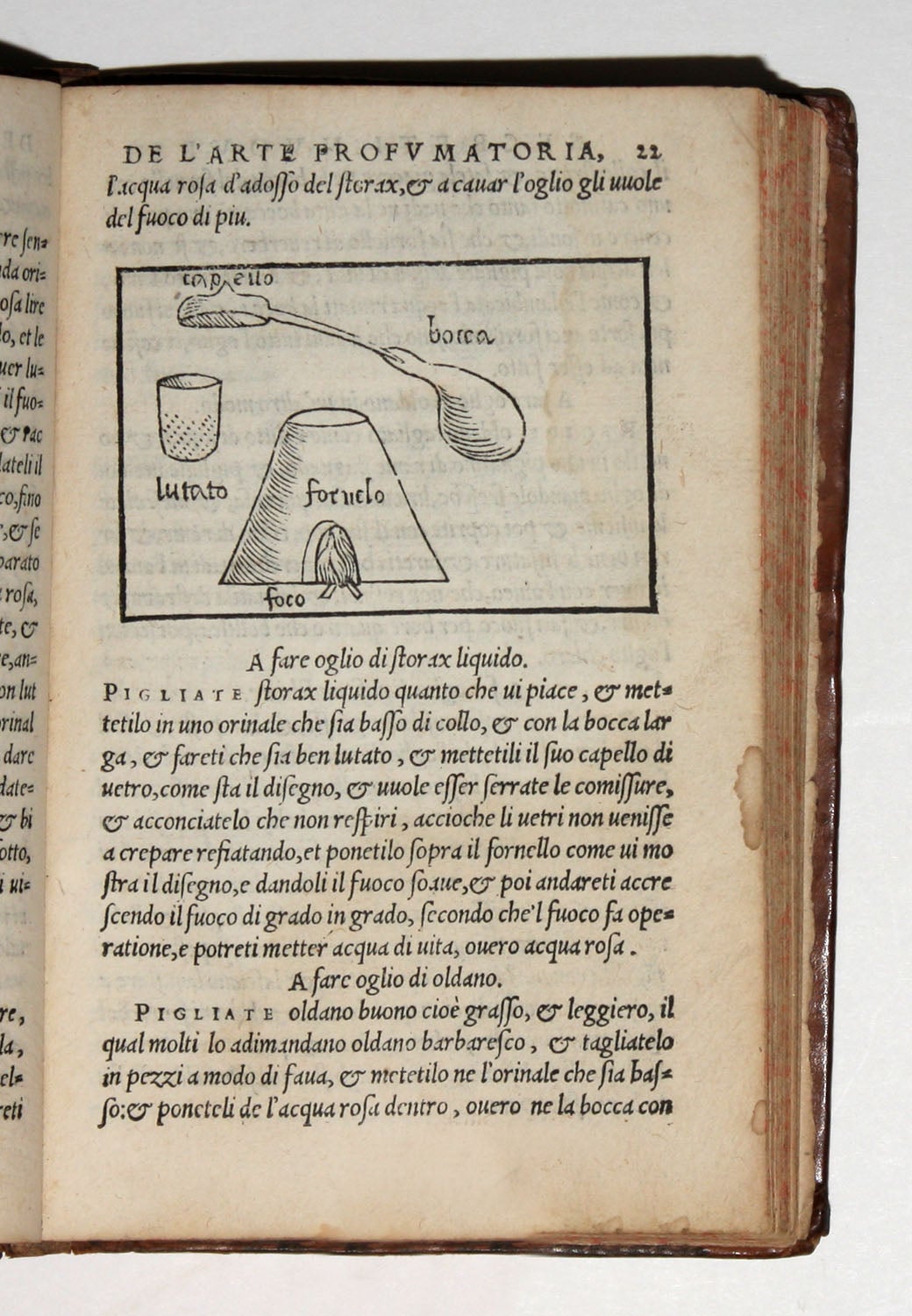
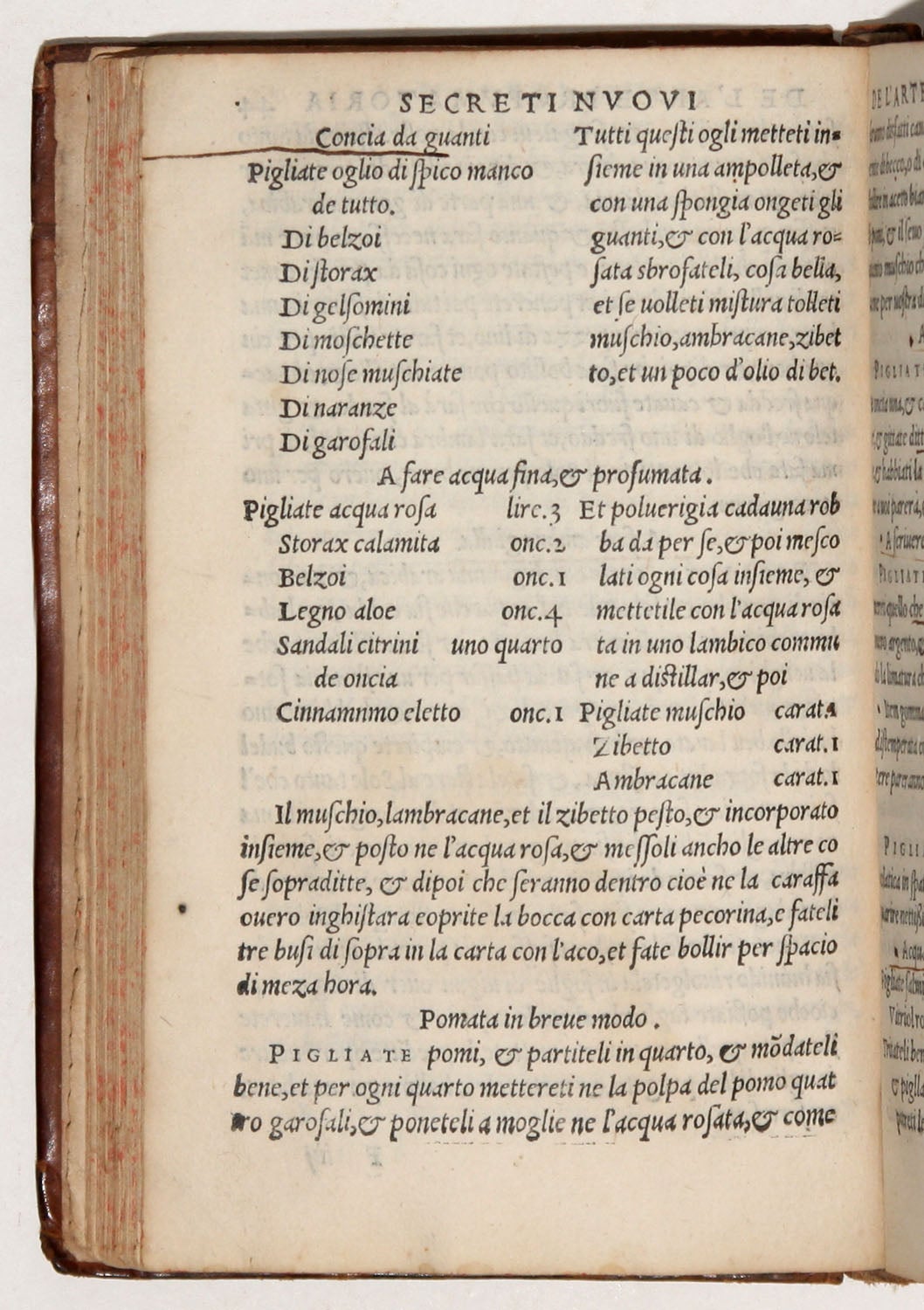
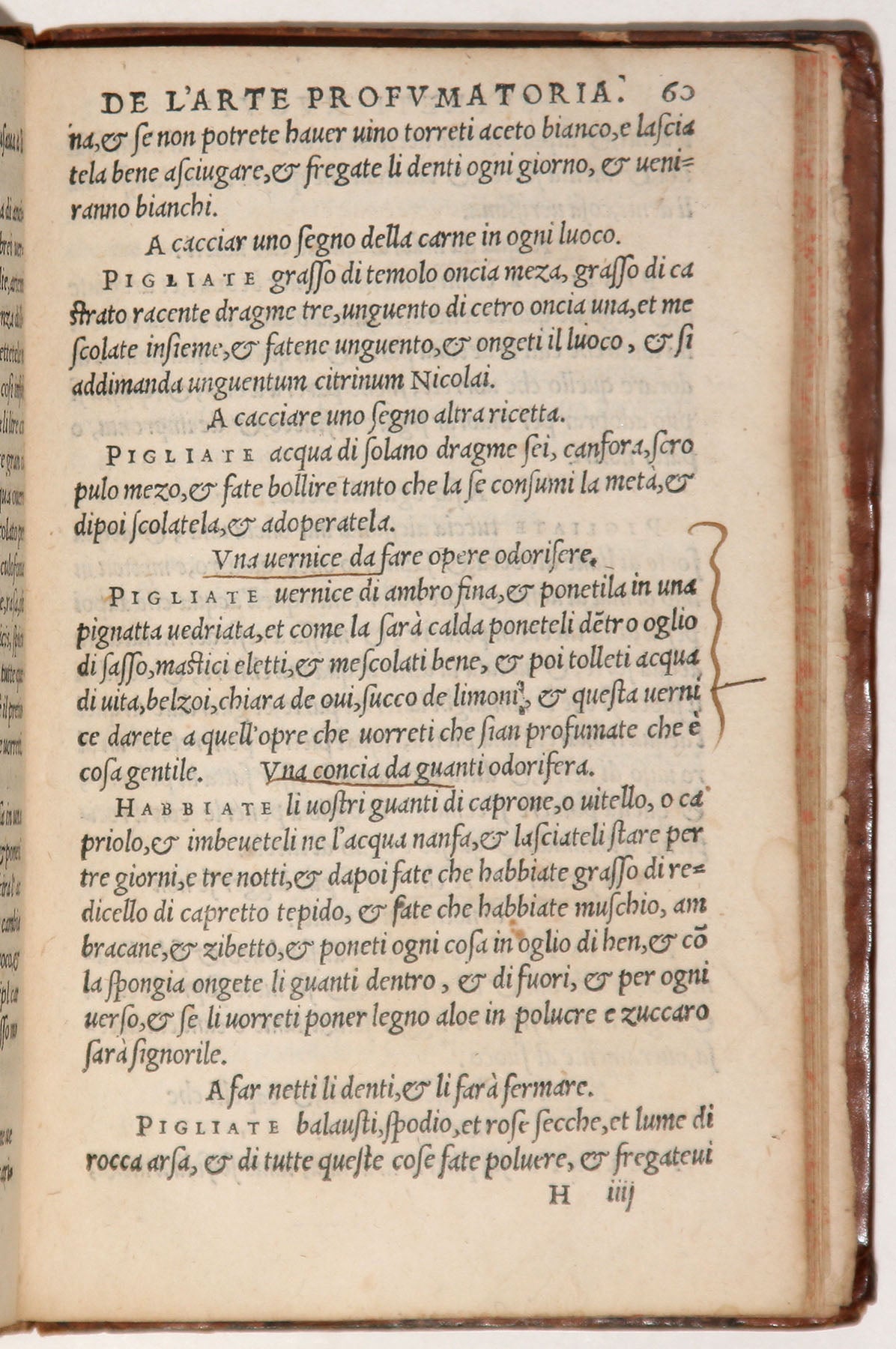
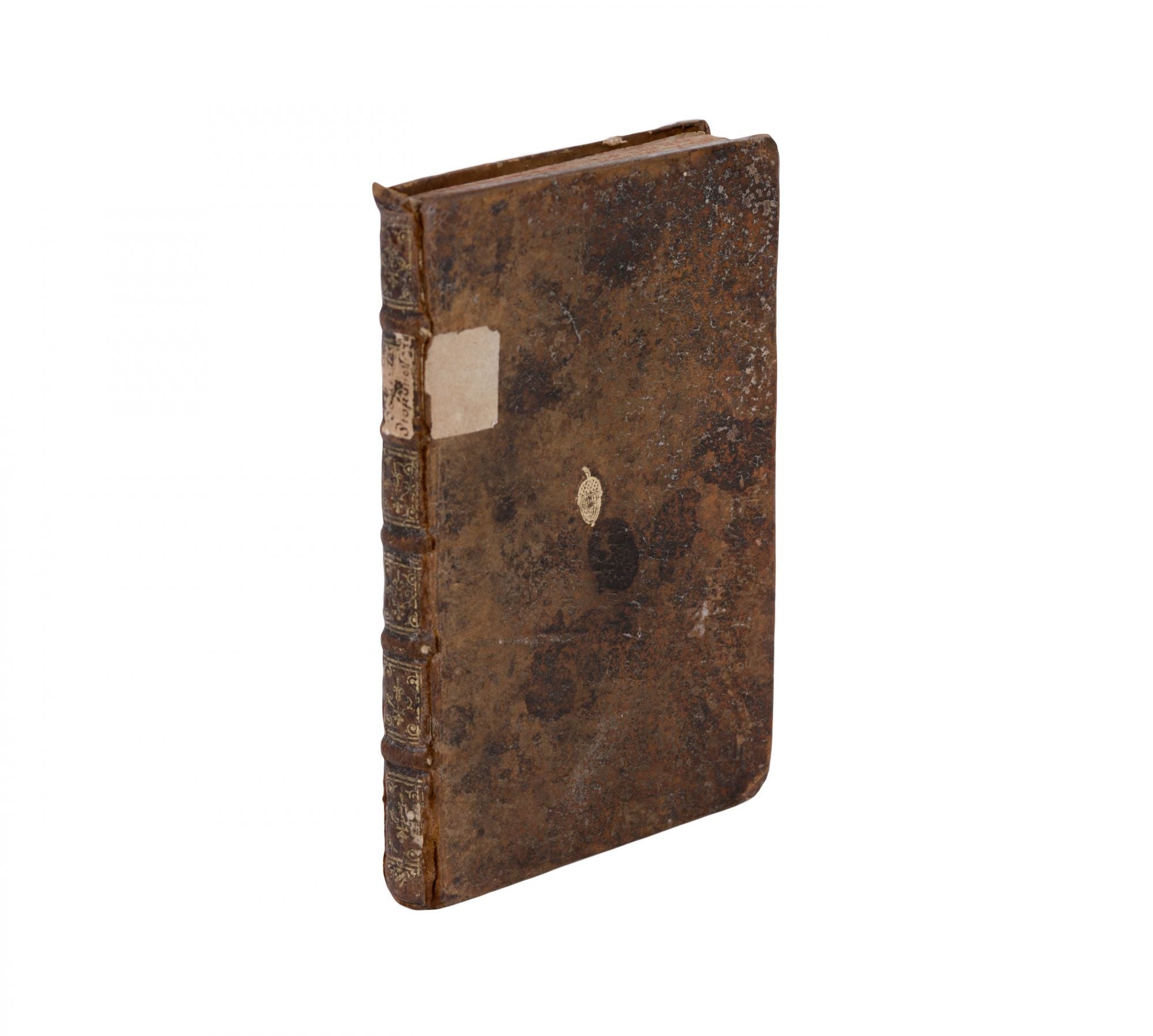
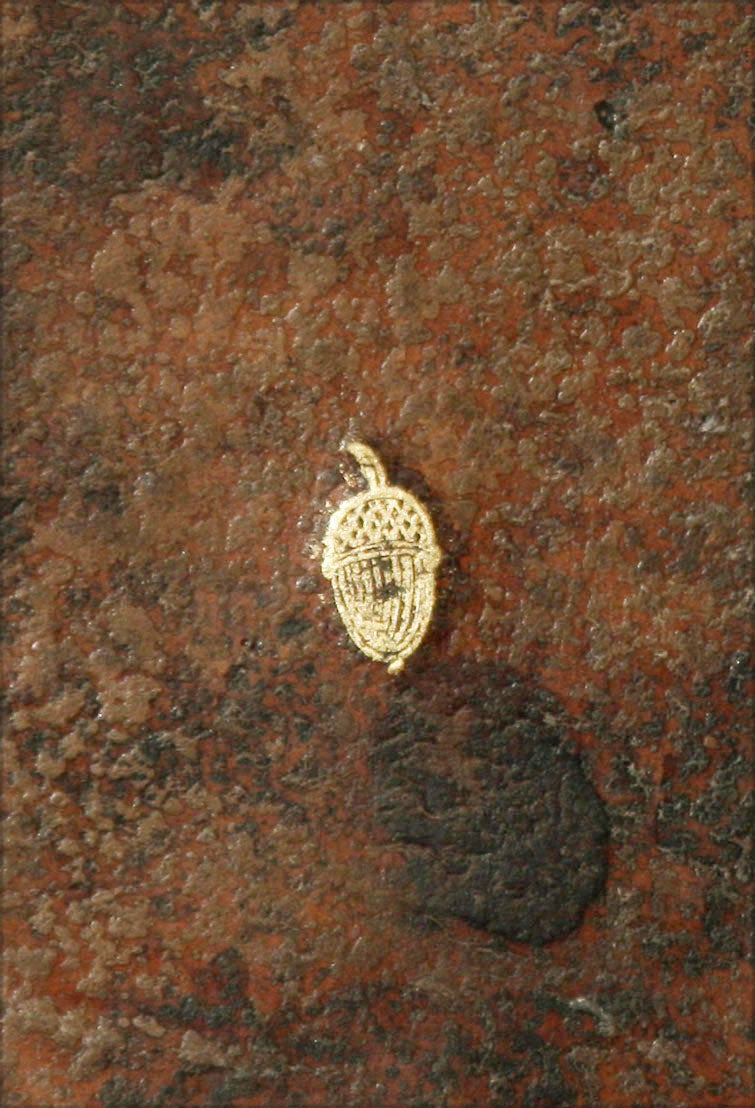
8vo (14.5 x 9.5 cm). 74, (6) ff., printed in italics, with three woodcut illustrations in the text showing distillation apparatus. Bound in 17th century European calf with gilt acorn emblem on boards, spine with gilt ornaments and paper manuscript title label. Repaired closed tear on f. A6. With copious underlining, manicula, and occasional annotations in an early hand, signed on the title page “Hatton” (possibly Sir Christopher Hatton, 1605-70, Member of Parliament and Controller of the Household to the king, exiled in 1648). Generally very good and genuine. Rare second edition (first 1555) of the first Western treatise on the art perfume making and cosmetics, containing over 300 recipes, which became something of a Venetian specialty in part because of that city’s supply of exotics from trade with the East, and in part for its fascination with feminine beauty and allure. The work forms part of a mid-16th century wave of professional books of technology which disclosed what previously were the “secrets” of professional guilds. To this end, and to avoid any repercussions from guild members, Rossetti does not sign the book, though his name is mentioned as author on p. 73. The “secrets” divulged include inter alia precise formulae for numerous recipes for perfumes, cosmetics, scented soaps, oils both essential and distilled, rouge or make-up, a special “Florentine” soap, whitening creams for face and freckles, creams to cure calluses, several remedies for teeth: toothpaste to whiten teeth, recipes to cure toothache, etc. Special attention is given to hair, with what we would now call “hair products” , including recipes for lightening hair and maintaining it as blond, for hair tint, as well as for growing hair or depilating hair, etc. “Roseto slides comfortably from perfumery, to cosmetics, to alchemy and early chemistry without seeing any necessity to draw distinctions between them” (Lawrence Witten, Catalog 1981), as he supplies recipes of chemical processes for making tints and color, varnishes, scents for fumigating or making poorly ventilated environments more commodious—a perennial concern in Venice—and how to manipulate various materials, how to soften crystal and coral, how to make various inks, invisible inks, varnishes, gilt, how to make gold ink, etc. The text includes several recipes for curing colds as well as some incorporating “storax” (a resin) and “Belzoi” (the gum or resin known as benzoin), both common ingredients in early pharmaceutical preparations prized for their antiseptic and aromatic properties. While brief, the preface is of interest from the standpoint of social history. The sophisticated, highly aestheticized culture of Italian courts never had sumptuary laws limiting the cultivation of feminine beauty, but one can discern a slightly defensive note in the author’s emphasis on the co-existence of personal adornment and virtue. He cites the widespread use of cosmetics among high-born women not only throughout Italy but the world. This is presumably because of the association of such artifice with Venetian courtesans, who no doubt used some of the techniques described and may or may not have been in need of the present book. Little is known of Rossetti, save that he is documented as being an official at the Venetian Arsenal from 1530-48. Rossetti was also responsible for the first printed book devoted exclusively to dyeing (Plicttho de larte de tentori, Venice, 1548; cf. Bibliotheca Tinctoria 0902). Both works may be considered as part of a wave of technology books, including Birninguccio and Agricola, which made trade secrets “public”. For the present edition, OCLC lists Library of Congress, National Library of Medicine, Folger, Hunt, Art Institute of Chicago, and UCLA. For the first edition of 1555, OCLC lists National Library of Medicine, Delaware, Harvard, Hunt, and Minnesota; Wellcome Institute has only this second edition. The text experienced a revival more than a century later, with later editions appearing in Bologna and in Venice in the 1670s. With thanks to Prof. Mirjam Foot of UCL, who suggested the ownership attribution of Sir Christopher Hatton.
* Adams N353; Sagarin, p. 215; R.J. Durling, A Catalogue of Sixteenth Century Books at the National Library of Medicine, p. 507.; F. Brunello & F. Facchetti, eds., Notandissimi secreti de l’arte profumatoria: Venezia 1555 (Vicenza, 1973); M. Ron, Bibliotheca Tinctoria, p. 338; also listed in A. Erdman’s bibliography, “Books on and for Women”, in My Gracious Silence: Women in the Mirror of 16th Century Printing in Western Europe (Lucerne, 1999), p. 189. Not in Osler, Waller, or Honeyman.
Price: $14,500.00