



Perspectiva hierinnen auffs kürtzte beschrieben mit exempeln er'et.
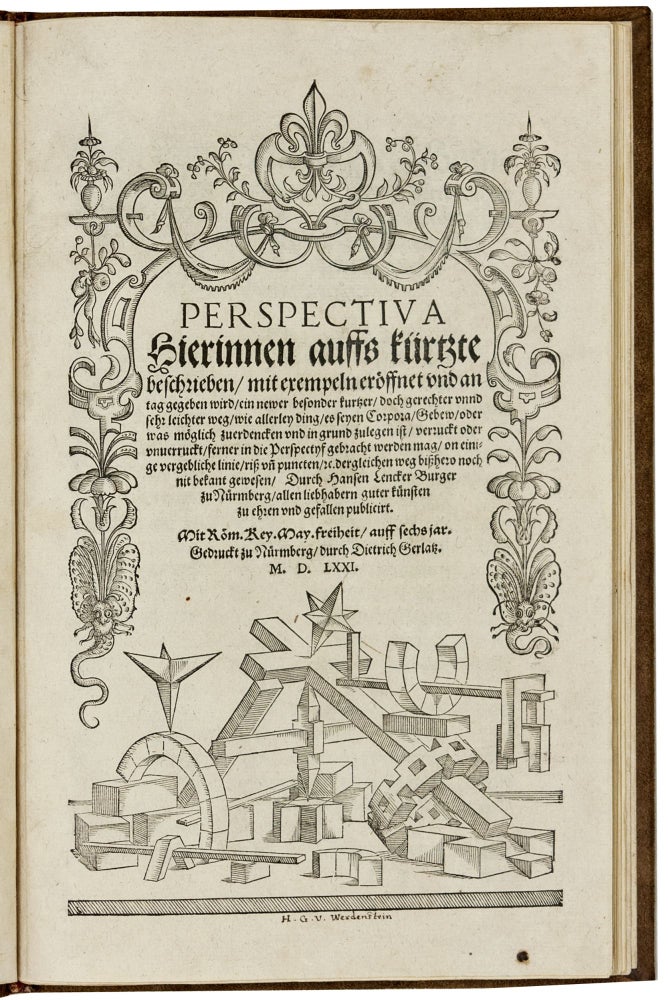
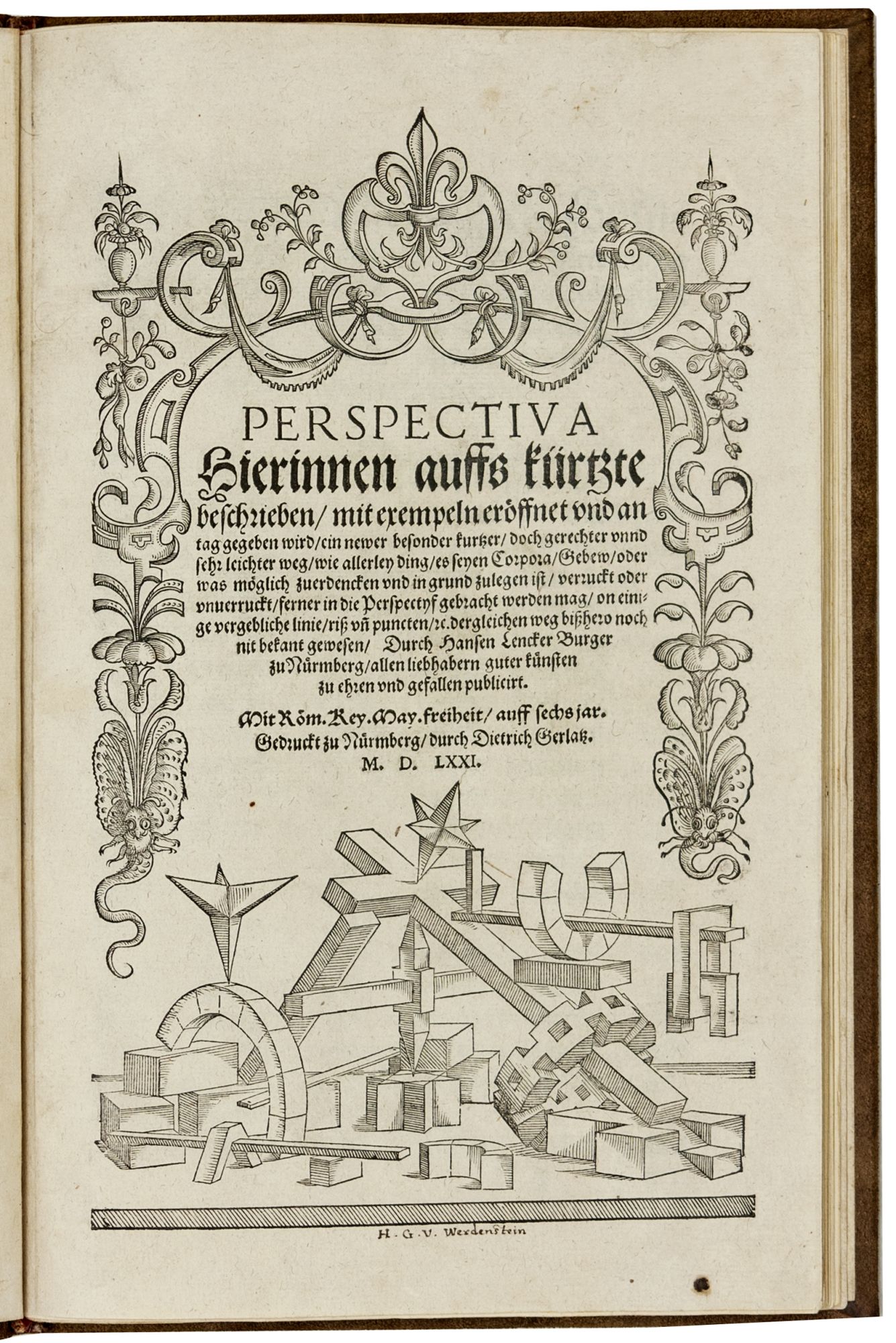
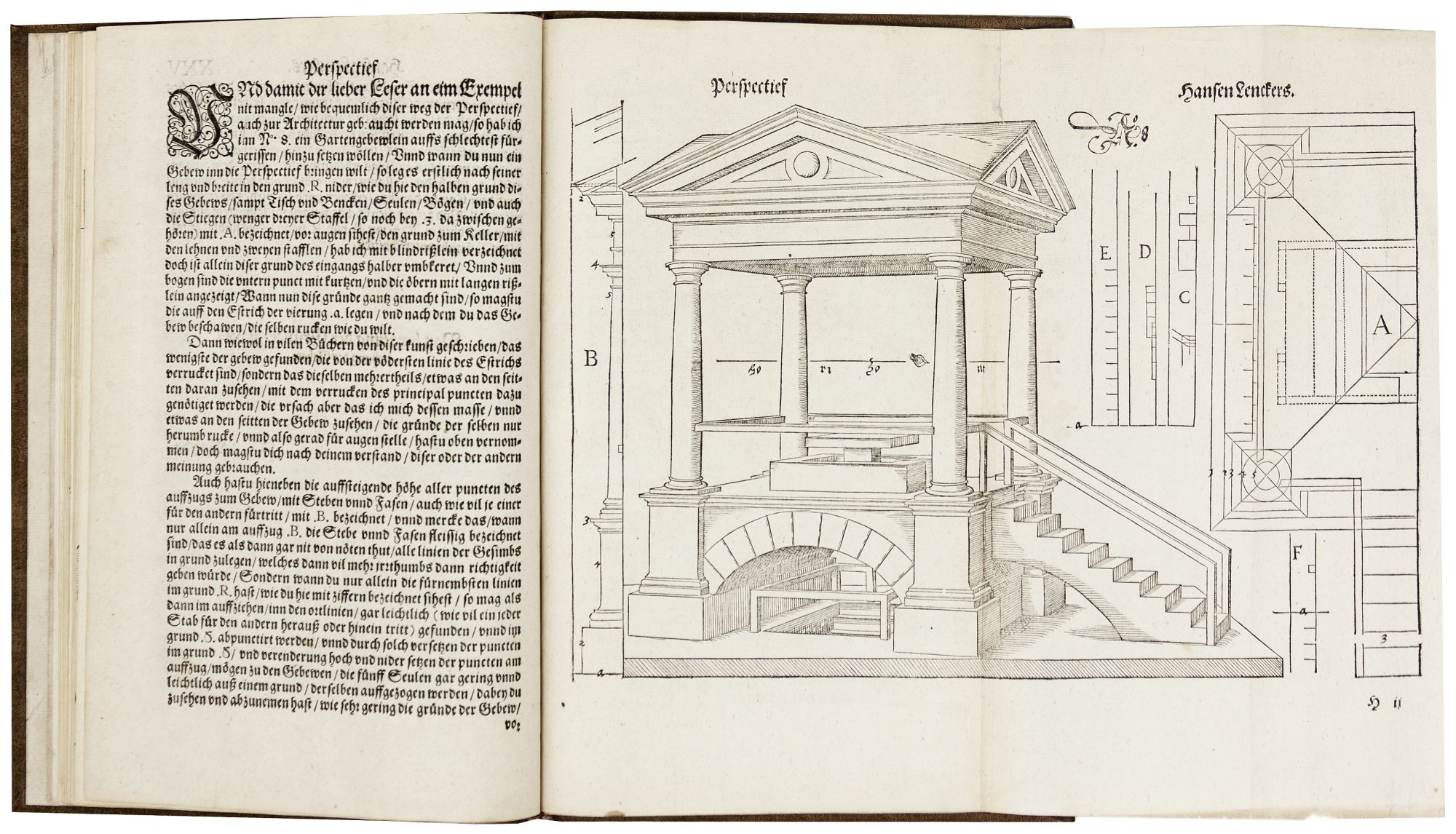
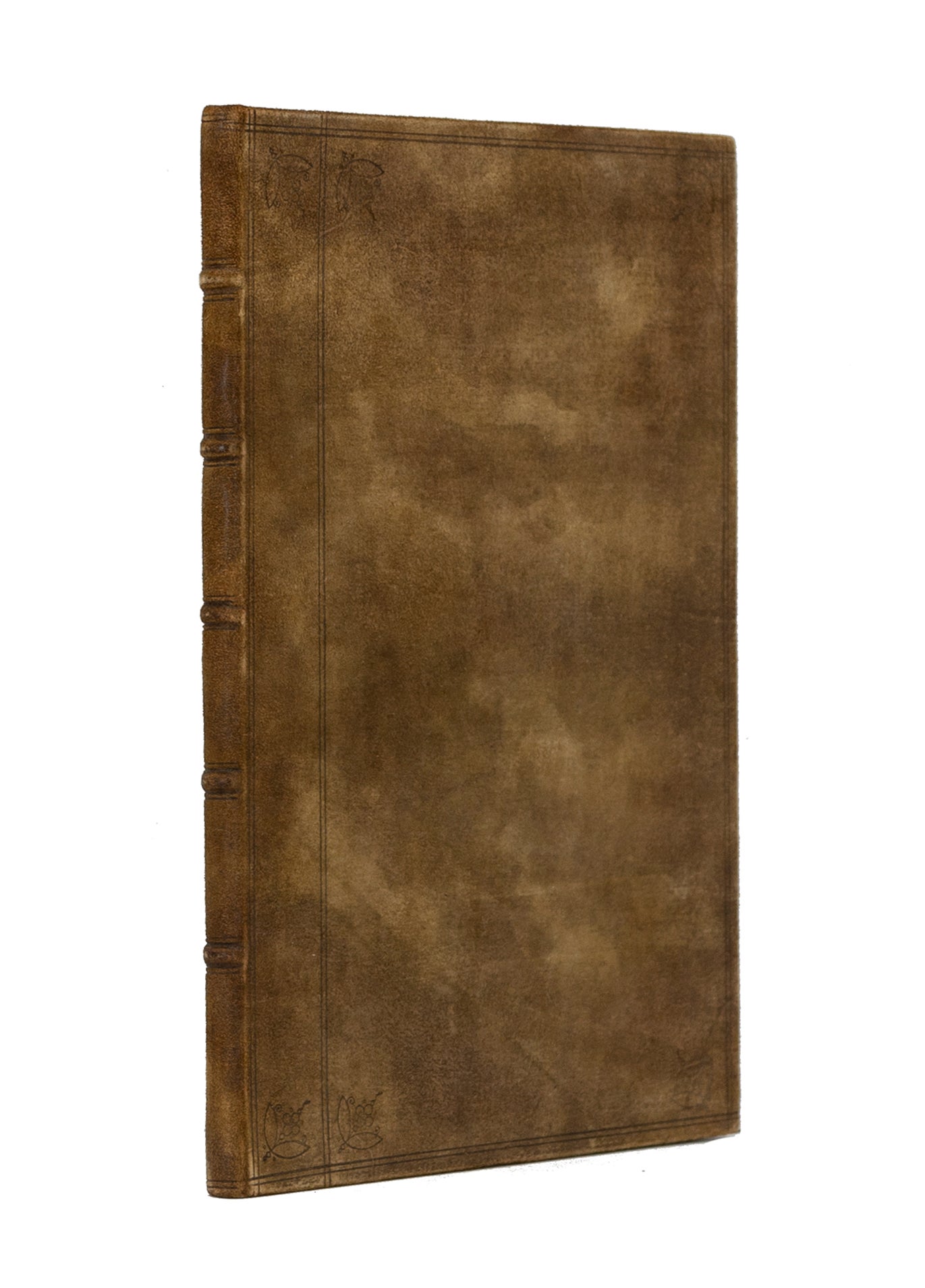
Small folio [29 x 19.5 cm], (6) ff., 29 ff., 1 blank, including woodcut title, 10 woodcuts in text, and with 1 double-page folding woodcut plate outside collation (between xxv-xxvi). Bound in reverse calf. Ownership inscription of H.G.V. Werdenstein stenciled at bottom of title; verso of xxiii slightly shaved just grazing image; minor repair to blank area of folding plate; slight discoloration at gutter of lvs. xxvii-xxix just touching text block; overall toning & minor soiling on title and scattered leaves, but generally very good. First edition, “become very rare” (Thieme-Becker XXIII, 45), of this illustrated perspective compendium, in the Nuremberg tradition of Kunstbuchleinen, which included such artists and goldsmiths as Stoer, Hirschvogel and Jamnitzer. The work follows and forms the technical counterpart to Lencker’s playful Perspectiva Literaria (1567), describing a drawing instrument of the author’s invention (pictured in the first plate). The numerous woodcuts show working diagrams and perspective representations of stereometric bodies—mostly elaborate variations on regular and semi-regular solids—and all matched to succinct text. “It teaches the method of perspective through illustrations of precisely constructed geometric solids and other objects in eleven full-page woodcuts, such as one demonstrating a skeletal, semiregular polyhedron and a spiral staircase (here improving smartly on the staircase attempted a generation earlier by Rodler). In his preface Lencker promises to give the reader not the useless ‘hull’ of the doctrine of perspective but the ‘kernel’. He notes that perspective is a noble art known to physicians and other authorities on nature and the heavens. Lencker explains his methods and instruments in a German-language text but insists on the primacy of the visual evidence" (Wood). “These model books, issued by professionals for fellow painters, architects, goldsmiths, carpenters, etc., were in constant use and soon worn out [which is] why very few copies have survived” (Ove Hagelin, The Art of Writing & Drawing, p. 133). The work has a brilliant mannerist title with the wooden or cardboard models of geometric solids called “Bossen”, a characteristic feature of Nuremberg perspective drawing. Hans Lencker (d. 1585) was, after Jamnitzer, the outstanding goldsmith and perspectivist of his day in the mannerist tradition. The present work earned him a post as perspective instructor to Christian I of Dresden. OCLC: Harvard, Cleveland, Marquette, Wisconsin, DuMenil, Winterthur, Yale.
* Berlin Kat. 4696; Vagnetti EIIb27 & <i>Il Processo di maturazione di una scienza</i> (1979); Honeyman 1985; Kemp, <i>Science of Art</i>, pp. 62-3; Christopher Wood, “The perspective treatise in ruins,” in <i>The treatise on perspective</i> (2003), p. 236.
Price: $12,500.00